Google AI Quests: The New Game Turning Classrooms into AI Research Labs
Google Research launches AI Quests, a free game for kids aged 11–14 to learn data science, train AI models, and solve real-world problems through play.

- What is Google AI Quests: A completely free and fun game by Google for kids aged 11 to 14
- Real Benefit of Playing: Developing a true understanding of AI and data without learning coding
- 3 Big Real-World Missions: Early flood warnings, eye disease detection, and mapping the human brain
- Help for Schools and Teachers: Ready-to-use classroom guides and full support from DeepMind
- How to Get Started: Any student can play directly without any fee or prior experience
Nowadays, whenever I see kids, they are either getting their homework done by AI on mobile phones or generating various types of images.
But is AI limited only to this? Not at all.
To change this mindset, Google Research has taken a wonderful initiative. In collaboration with Stanford, they have launched a completely free online game called “AI Quests”.
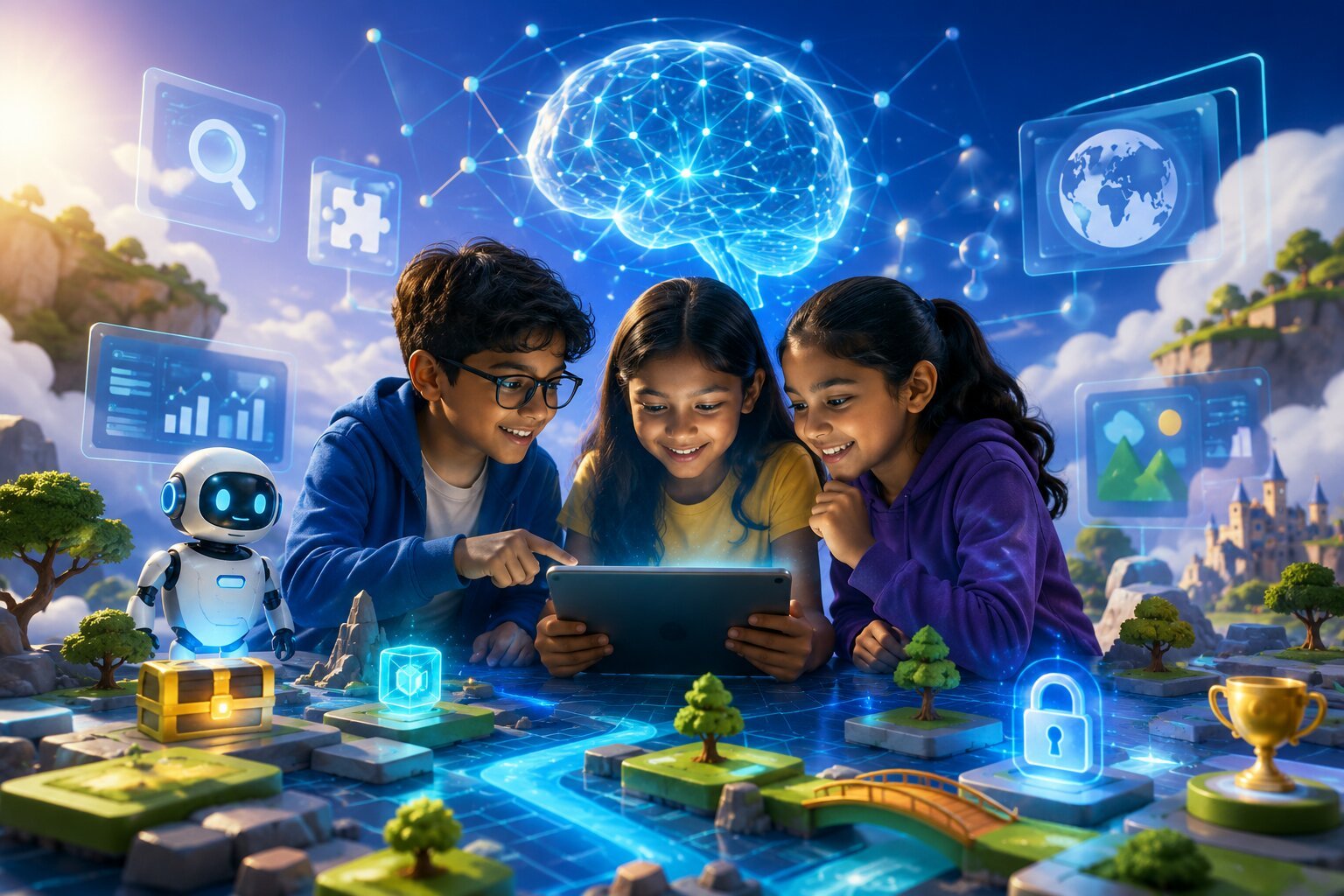
This game is for kids aged 11 to 14. Its purpose is to help children learn through play how AI actually works and how it solves real problems of the world.
Let us now understand what AI Quests is and how it works.
How can teachers and parents benefit from it? First of all, let us understand what AI Quest is.
What is AI Quests?
AI Quests is an immersive adventure game where students play the role of a ‘Google Researcher’.
During the game, they have a virtual mentor, “Professor Skye”, who guides them at every step.
The main purpose of this game is to promote AI Literacy among kids. Inside the game, students make mistakes, reflect on their decisions, and learn how to train their AI models by understanding data quality.
3 Main Adventures of AI Quests
Even though this game is set in a fantasy world, the challenges inside are completely real. Google has included three of its major research projects:
1. Flood Forecasting Challenge
This is based on Google’s actual Flood Forecasting Research. In this, kids learn how people can be alerted before floods arrive with the help of AI.
- Students’ Role: They collect data sources regarding rainfall and river flows.
- What They Learn: Evaluating data quality, training the AI model, testing it, and understanding how human decisions affect AI outcomes.
2. Diabetic Retinopathy Detection
This is based on a Google AI model that can detect diabetic retinopathy (a disease that can lead to vision loss) in its early stages. Kids will learn how medical science and AI work together to help save people’s lives.
3. Mapping the Brain (Connectomics)
Through this, kids will be able to closely understand the complex structure of the human brain and how it works using AI.
Special Highlight: After completing every challenge, students receive a video message from the actual Google researchers who built this technology. This helps kids understand how Responsible AI is practiced.
Why is this Special for Schools?
Google has designed AI Quests in a way that it can be easily integrated into any school curriculum.
- Ready-made Lesson Plans: Teachers get a complete Teacher Guide along with classroom activities.
- Global Partnerships: Raspberry Pi Foundation and Google DeepMind’s ‘Experience AI’ program are including it in their global curriculum. Stanford’s CRAFT network is also supporting it.
- Completely Free: Any teacher or institution can access it directly from Google’s website.
Frequently Asked Questions (FAQs)
Q1. What is the right age for kids to play AI Quests?
Ans: This platform is primarily designed for students aged 11 to 14 years (Classes 6 to 9).
Q2. Is there any fee to use AI Quests?
Ans: No, it is a completely free, open-source educational tool developed by Google Research.
Q3. Can parents make their kids play this at home?
Ans: Yes, any teacher, institution, or parent can directly access it by visiting Google’s official website.
Q4. Is it necessary for kids to know coding for this?
Ans: Not at all! This is a no-code, story-based game where kids learn AI concepts, data analysis, and logical thinking instead of coding.
Conclusion
In this era of technology, simply teaching kids to use AI is not enough. It is important that they understand AI, build things themselves, and think about new possibilities. Google’s AI Quests is a step in this direction.
Instead of rote learning, it teaches kids in a practical way how big real-world problems can be solved by combining data with human thinking.
If you are a teacher or a parent, make your kids a part of this digital adventure today and watch them move toward becoming future scientists while playing!