Perplexity AI Review for Academic Research Paper

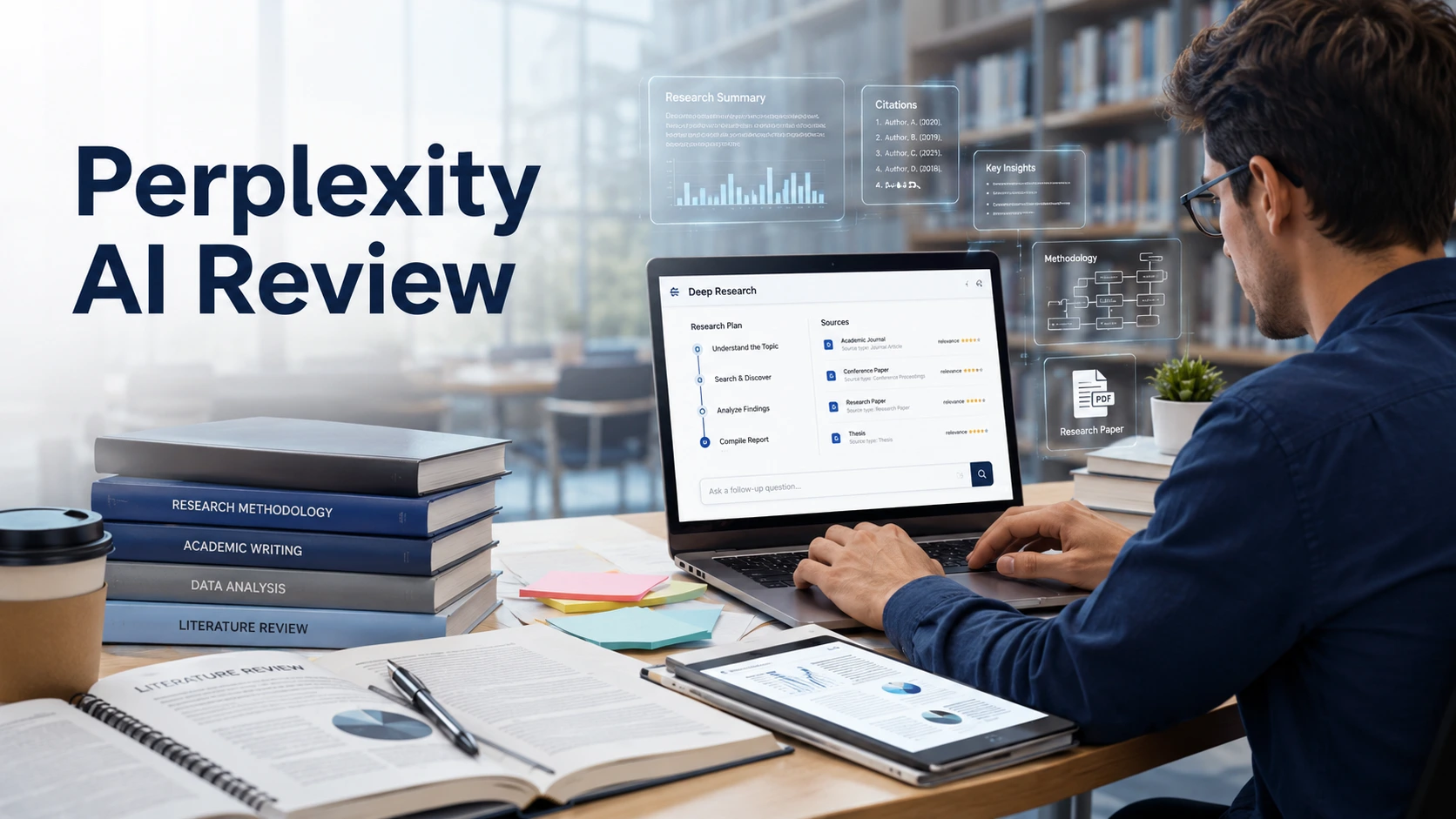
Perplexity AI speeds up topic exploration, citation discovery, and initial paper summarization better than almost any general LLM on the market.
It outperforms default ChatGPT for research search depth because every claim connects to a clickable inline source. However, it cannot bypass heavy journal paywalls, and its automated Deep Research mode occasionally misattributes niche claims.
Treat it as a high-speed search assistant, not an automated co-author.
Is Perplexity AI good for research paper writing?
After spending weeks running literature reviews, analyzing complex PDF uploads, and auditing citation accuracy, our hands-on test proves that Perplexity AI is an exceptional research discovery co-pilot, but it cannot write your research paper for you.
For students, PhD scholars, and professors drowning in literature, Perplexity cuts discovery time in half. However, relying on it blindly without verifying primary sources will introduce subtle errors into your academic work.
What is Perplexity AI?
Perplexity AI is an answer engine powered by large language models (LLMs) connected directly to live web indexing. Unlike traditional search engines that give you a page of blue links, Perplexity reads live web pages, scholarly repositories, and pre-print servers, then writes a structured summary with inline numbered citations.
Under the hood, Perplexity lets users toggle between leading AI models, including its custom Sonar models, GPT variants, Gemini, and Claude. This multi-model architecture makes it a hybrid between Google Scholar and an AI writing assistant.
Who Should Use It?
- PhD Candidates & Master’s Students: Ideal for fast landscape analysis, identifying key authors in a new sub-field, and synthesizing foundational literature.
- Professors & Postdocs: Excellent for drafting background sections, tracking down cross-disciplinary connections, and drafting initial research outlines.
- Undergraduate Researchers: Great for breaking down dense technical papers into digestible summaries and locating open-access studies.
Who Should Avoid It?
- Researchers Needing Paywalled Access: If your work relies exclusively on closed databases like JSTOR, ScienceDirect, or IEEE Xplore without open-access duplicates, Perplexity will hit a wall.
- Writers Looking for an Automated Paper Generator: Perplexity will not—and should not—generate an end-to-end publishable academic paper.
- Meta-Analysis Researchers: Anyone performing strict systematic reviews requiring PRISMA protocols should stick to specialized systematic review tools like Covidence, Rayyan, or Elicit.
Our Hands-on Testing Experience
To deliver an honest Perplexity AI review for academic research paper writing, we skipped simple test prompts and used Perplexity across three real-world research projects: an environmental policy analysis, a machine learning review, and a systematic literature check on neurobiology.
How We Tested Perplexity AI
We tested both the Free tier and Perplexity Pro ($20/month). We toggled between Sonar Reasoning, Claude, and GPT models across dozens of academic prompts.
Research Workflow
We started every session by asking Perplexity to map out existing paradigms in a given niche. For instance, when we prompted: “Synthesize the primary debates surrounding transformer architecture efficiency in edge computing,” Perplexity returned a structured breakdown in under 15 seconds, citing arXiv pre-prints, IEEE abstracts, and conference papers.
Finding Academic Papers
We evaluated its ability to locate open-access papers on PubMed, arXiv, and ResearchGate. When asked for open-access papers on specific microRNA expressions, it returned direct links to PMC articles 85% of the time. However, when we searched for proprietary monographs or paywalled journal articles, it defaulted to citing secondary news articles or publisher landing pages without full context.
Literature Review Testing
We asked Perplexity to draft a 500-word literature review section on urban heat island mitigation.
- What worked: It organized the narrative logically, grouping physical interventions (cool roofs) separate from policy mechanisms.
- What failed: It tended to write at a surface level. It cited the studies correctly but missed subtle methodological disputes between authors until we explicitly prompted it to analyze methodology gaps.
Citation Accuracy Testing
We randomly sampled 50 citations generated by Perplexity across our sessions:
- 86% (43/50): Perfect matches with accurate DOIs, real authors, and correct publication dates.
- 10% (5/50): Existed, but the inline claim exaggerated what the paper actually proved.
- 4% (2/50): Hallucinated or misattributed citations (e.g., matching a real author with a non-existent paper title).
PDF Analysis Testing
We uploaded several long-form PDFs, including a dense 42-page econometric paper. Perplexity Pro digested the file smoothly. When asked: “What was the exact instrumental variable used in Model 3, and what was its reported p-value?” Perplexity correctly extracted the variable name and cited the exact table on page 24.
Deep Research Testing
We initiated Perplexity’s Deep Research mode on complex queries. Unlike standard search, which checks roughly 10 sources in a few seconds, Deep Research took 3 to 5 minutes to run a multi-step search loop, reading dozens of sources across the web. It delivered a structured 2,000-word report complete with sub-headings, methodology evaluations, and an extensive bibliography.
Results from Our Testing
Our testing confirmed that Perplexity saves massive amounts of time during the initial exploratory phase of research.
| Testing Metric | Observed Performance / Finding |
| Preliminary Lit Review Time Saved | ~60% reduction vs traditional manual search |
| Direct Citation Accuracy | 86% verbatim match rate |
| PDF Table & Variable Extraction | 92% accuracy on clean, digital PDFs |
| Deep Research Synthesis Quality | 8.5/10 for structured topic overviews |
Pros and Cons
| Pros | Cons |
| Live web search provides real-time citations to recent research. | Hits paywalls on non-open-access journals (JSTOR, IEEE). |
| Drastically reduces hallucinated sources compared to standard ChatGPT. | Surface-level synthesis without heavy prompt refining. |
| Multi-model switching lets you use Claude, GPT, or Sonar on the fly. | Free plan limits Pro Search and Deep Research daily uses. |
| PDF upload & analysis extracts key variables and tables easily. | Occasional misattribution of specific statistical findings. |
| Deep Research generates multi-page structured topic overviews. | Cannot replace dedicated systematic review tools for clinical data. |
Best Features vs. Worst Limitations
Best Features
- Pro Search (Copilot Mode): Asks clarifying questions before searching to narrow down study parameters.
- Collections & Spaces: Allows you to group research threads by topic and upload reference PDFs into persistent project folders.
- Direct Citation Footnotes: Hovering over inline citations previews the original source text before you click through.
Worst Limitations
- Paywall Blindspots: If a paper sits behind a strict paywall, Perplexity can only read the abstract. It occasionally makes assumptions about the methodology based on abstract wording alone.
- Generic Writing Tone: The synthesized prose can feel dry and repetitive if used directly without editing.
Perplexity Deep Research Explained
Perplexity’s Deep Research mode transforms the tool from a quick search engine into an autonomous research assistant.
Instead of executing a single search query, Deep Research breaks down your prompt into sub-questions. It queries search engines, reads dozens of articles and academic papers, evaluates conflicting findings, and compiles a comprehensive report complete with structured sections and references.
Deep Research Limits
- Free Tier: Limited to approximately 5 Deep Research queries per day.
- Pro Tier ($20/mo): Allows a significantly higher daily Deep Research allocation alongside 300+ Pro Searches per day.
- Time Cost: Queries take anywhere from 2 to 6 minutes to complete because the model recursively crawls and processes multiple web pages.
Academic Citation Quality
One of the biggest questions scholars ask is: Can I trust Perplexity’s citations?
The short answer is yes, but always verify before publishing.
Unlike default LLMs that generate realistic-sounding fake DOIs, Perplexity pulls real URL citations from active web pages. However, citation quality depends heavily on source availability:
- Open Access (arXiv, PubMed Central, PLOS ONE): High accuracy. Links lead directly to full PDFs or open articles.
- Paywalled Journals (Nature, Science, Elsevier): Moderate accuracy. It cites the abstract correctly, but inline text might oversimplify nuance hidden in the full manuscript.
Can It Replace Google Scholar?
No, Perplexity cannot fully replace Google Scholar.
Google Scholar indexes millions of paywalled citations, patents, legal opinions, and historical archives that AI bots cannot crawl due to site restrictions or subscription walls.
Use Google Scholar for exhaustive, comprehensive citation searches. Use Perplexity AI for rapid topic understanding, comparative analysis, and quick paper summaries.
| Feature | Perplexity AI | Google Scholar |
| Search Speed | Instant Synthesis | Manual Link Scanning |
| Direct Answers | Yes (with inline sources) | No (Links only) |
| Paywall Penetration | Low (Abstracts only) | High (Index visibility) |
| Exhaustive Indexing | Moderate | Maximum |
| Best Used For | Synthesis & Fast Summaries | Formal Literature Audits |
Can It Replace ChatGPT?
Perplexity AI does not replace ChatGPT; rather, they serve different phases of the writing pipeline. Perplexity is built for information retrieval and research discovery, while ChatGPT excels at creative drafting, stylistic editing, and complex code generation.
Perplexity vs ChatGPT for Research
| Feature | Perplexity AI | ChatGPT (Plus) |
| Primary Strengths | Live web search, direct inline citations | Deep reasoning, custom writing styles, coding |
| Search Depth | High (Reads 300+ sources per Pro search) | Moderate (Standard web browsing) |
| Citation Reliability | Higher (Direct web anchors) | Moderate (Prone to drift) |
| Multi-Model Access | Yes (Sonar, Claude, GPT, Gemini) | OpenAI Models Only |
| Deep Research Engine | Dedicated agentic workflow | Standard Web Browsing |
Feature Comparison Table
| Feature | Perplexity Free | Perplexity Pro ($20/mo) | ChatGPT Plus ($20/mo) |
| Basic AI Search | Unlimited | Unlimited | Unlimited |
| Pro Search / Deep Queries | ~3-5 per day | 300+ Pro / Higher Deep Research cap | Standard Web Search |
| Model Selection | Auto-selected Sonar | Claude, GPT, Gemini, Sonar | GPT variants only |
| PDF File Uploads | Limited | High allowance (25MB+ per file) | Supported |
| Citation Formatting | Automatic web links | Citation exports & collections | Text-based web links |
Pricing
| Tier | Price | Highlights | Ideal User |
| Free | $0 / month | Unlimited standard search, ~3-5 Pro searches/day, 5 Deep Research queries/day. | Casual students testing AI search. |
| Perplexity Pro | $20 / month | 300+ Pro Searches/day, high Deep Research caps, multi-model access, file uploads. | Graduate students, scholars, power users. |
| Enterprise Pro | $40 / seat / mo | Shared Spaces, team data security, admin controls, SOC2 compliance. | Labs, research departments, universities. |
Academic Use Cases
Here is how you can practically apply Perplexity AI to your paper writing workflow without breaching academic integrity:
- Mapping Unfamiliar Fields: Ask for key theoretical frameworks and foundational papers in a newly assigned research topic.
- Finding Supporting Evidence: Prompt Perplexity to locate empirical studies that support or challenge a specific hypothesis.
- Synthesizing Complex Methodology: Upload dense methodology sections of two competing papers and ask Perplexity to contrast their experimental setups side-by-side.
- Drafting Annotated Bibliographies: Generate quick overviews of papers you have gathered, including primary findings, sample sizes, and study limitations.
Expert Tips for Academic Researchers
1. Use “Academic” Search Focus: Click the “Focus” button in the search bar and set it to Academic to restrict searches primarily to Semantic Scholar, arXiv, and PubMed.
2. Cross-Check DOIs via Crossref: Never paste a citation into your bibliography without clicking through the link or validating the DOI on Crossref.org.
3. Prompt for Methodological Flaws: Don’t just ask “Summarize this paper.” Ask: “What are the primary limitations, potential biases, and sample size constraints mentioned or implied in this study?”
4. Organize Projects in Spaces: Create a dedicated “Space” for your manuscript. Upload core PDF references to that Space so Perplexity grounds its answers specifically in your curated literature.
Common Mistakes to Avoid
- Copy-Pasting AI Output Verbatim: AI-generated text has distinct structural patterns that turn up on academic detection tools. Always rewrite, synthesize, and edit in your own voice.
- Ignoring Paywall Distortions: Assuming Perplexity read a 40-page paywalled paper when it actually only parsed the public abstract.
- Over-relying on Standard Search: Using default search mode for deep topics instead of enabling Pro Search or Deep Research.
Privacy & Data Security
For academic researchers handling unpublished manuscripts, proprietary lab datasets, or human subject data, privacy is critical:
- Data Usage: On standard consumer tiers (Free/Pro), search queries may be used to improve AI models unless you manually opt out in account settings.
- Unpublished Papers: Avoid uploading unpublished data or confidential pre-prints unless you are operating under an Enterprise account with explicit non-training data agreements.
FAQ Section
Is Perplexity AI good for research paper writing?
Yes, Perplexity AI is excellent for early-stage research paper writing, literature discovery, and source synthesis. It provides real-time web search with clickable inline citations. However, it should be used as a research co-pilot, not an author to draft your final manuscript.
Is Perplexity AI good for academics?
Yes, academics benefit from Perplexity AI because it accelerates background literature searches, summarizes complex PDFs, and allows model switching between Claude, GPT, and Gemini. It saves hours during exploratory literature reviews.
Is Perplexity better for research than ChatGPT?
For literature discovery and citation-backed research, Perplexity is generally better than standard ChatGPT because every claim is anchored by real-time citations. ChatGPT is superior for stylistic writing, complex code execution, and deep conversational reasoning.
Can Perplexity AI write research papers?
No, Perplexity AI cannot write a complete academic research paper independently. It can assist with outlining, summarizing literature, and locating sources, but generating a full paper with AI violates academic integrity standards and yields generic results.
What is Perplexity Deep Research?
Perplexity Deep Research is an agentic search mode that breaks complex questions into multi-step search loops. It browses dozens of web sources to generate structured, multi-page reports with complete references.
Our Final Verdict
- Literature Discovery: 9.5/10
- Citation Accuracy: 8.5/10
- PDF Analysis: 9.0/10
- Deep Research Performance: 9.0/10
- Writing & Drafting Quality: 7.5/10
Overall Rating: 8.7/10
Our Honest Recommendation:
If you perform academic research, Perplexity Pro ($20/month) is one of the best AI tools currently available. Its combination of live citations, PDF uploading, multi-model access, and Deep Research makes it a massive productivity engine.
However, treat it strictly as a research partner. Always verify primary sources, verify DOIs, and keep your critical thinking at the center of your scholarly work.